
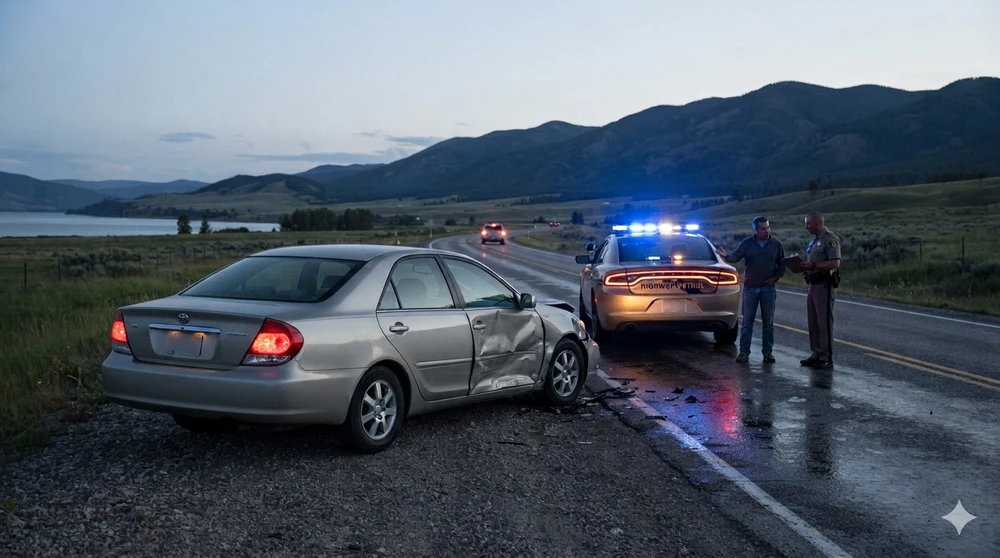
A normal car accident is stressful enough. A hit-and-run adds another problem immediately: the person who caused the crash is gone.
Maybe another vehicle sideswipes you on Highway 93 and keeps driving. Maybe a driver runs a red light in Kalispell, causes a collision, and leaves before law enforcement arrives. Or perhaps a vehicle forces you off the road without ever making contact. Suddenly, you are dealing with an injury claim without knowing the name, insurance company, or even the identity of the other driver.
That does not necessarily mean there is no way to recover for the injuries. But a hit-and-run claim puts unusual importance on early evidence and on understanding the insurance coverage that may be available.
A Local Example
Imagine a driver heading home near Polson after dark. An approaching pickup drifts across the center line. To avoid a head-on collision, the driver swerves, leaves the roadway, and crashes. The pickup never stops.
There may be no license plate number and no immediate way to identify the pickup driver. The injured person is transported for medical care, while law enforcement begins with only a description of the vehicle and the physical evidence at the scene.
In a case like this, two investigations may be happening at once: one to identify the fleeing driver and another to determine whether an insurance policy can respond if that driver is never found.
Report the Hit-and-Run as Soon as Possible
A prompt law-enforcement report creates an official record of what happened and gives investigators an opportunity to look for the fleeing vehicle. Depending on the circumstances, officers may be able to use witness information, debris, paint transfer, traffic cameras, nearby surveillance video, or vehicle descriptions to narrow the search.
If you are physically able, give law enforcement as much accurate information as you can remember. Vehicle color, body style, direction of travel, partial plate information, damage, stickers, lights, or other distinctive details can become important later.
Do not delay medical care in order to investigate the crash yourself. Your health comes first, and serious injuries are not always obvious at the scene.
Evidence Can Disappear Quickly
Hit-and-run cases often depend on evidence that has a short life. A business near the roadway may have surveillance footage that is automatically overwritten. A homeowner’s doorbell camera may have captured a vehicle passing moments after the crash. Witnesses may remember a distinctive truck today but far less several weeks later.
Photograph vehicle damage, debris, skid marks, the roadway, visible injuries, and anything else that may help reconstruct what happened. Save dash-camera footage immediately if it exists. If witnesses stopped, obtain their contact information rather than assuming their names will appear in a police report.
Even if the other driver is never identified, this evidence can still matter when an insurance company evaluates whether an unknown vehicle actually caused the accident.
Your Own Insurance Policy May Become Important
When the at-fault driver cannot be identified, there may be no liability insurer to contact on that driver’s behalf. That is when the injured person’s own automobile coverage can become particularly important.
Montana law requires insurers issuing applicable motor-vehicle liability policies in the state to offer uninsured motorist coverage, although a named insured may reject that coverage. Whether uninsured motorist coverage applies to a particular hit-and-run or unidentified-vehicle accident depends on the policy language and the facts.
Other portions of an auto policy may also be relevant. The important step is to obtain and review the actual policy and declarations rather than assuming that a hit-and-run is either automatically covered or automatically excluded.
What If There Was No Contact Between the Vehicles?
Not every hit-and-run involves a collision between two vehicles. A driver may cross the center line, pull out unexpectedly, or force another motorist off the roadway and then leave without making physical contact.
These so-called phantom-vehicle situations can raise difficult proof and insurance questions. The fact that the vehicles did not touch does not by itself tell you whether a claim exists. The policy language, available evidence, and circumstances of the crash need to be examined carefully.
That makes independent evidence especially valuable. Witnesses, video, roadway evidence, emergency calls, and a prompt police report can help establish that another vehicle was involved rather than leaving the injured driver with only an unexplained single-vehicle crash.
What If Police Find the Driver Later?
If law enforcement later identifies the fleeing driver, the insurance picture may change. The driver may have liability insurance, may be uninsured, or may dispute involvement in the crash. There may also be evidence from the other vehicle that helps establish what happened.
Finding the driver does not automatically resolve the injury claim. Fault, insurance coverage, the extent of the injuries, and damages still have to be addressed. But identification can add another potential source of evidence and, in some cases, another source of insurance coverage.
Do Not Rush to Close the Claim
After a hit-and-run, an injured person may be relieved simply to learn that some insurance coverage might exist. That does not mean the claim should be resolved before the medical picture is clear.
Some injuries worsen over time or require imaging, specialist care, physical therapy, surgery, or extended recovery. Before agreeing to a final settlement, it is important to understand the nature of the injury, expected treatment, lost income, and other losses associated with the crash.
It is also important to understand what rights may be affected by signing a release or accepting payment. A quick resolution can be difficult to undo later.
Common Questions
Can I have a claim if the hit-and-run driver is never caught? Potentially. Your own insurance coverage may become relevant when an at-fault driver cannot be identified, depending on the policy and facts.
Does uninsured motorist coverage automatically cover every hit-and-run? Do not assume that it does. Coverage depends on the applicable policy language, the circumstances of the accident, and Montana law.
What if the other vehicle never actually hit mine? A no-contact or phantom-vehicle accident can raise additional proof and coverage issues. Preserve independent evidence and have the policy and facts reviewed carefully.
Should I notify my insurance company? A hit-and-run can trigger notice requirements under your own policy. Prompt reporting is generally important, but understand what information is being requested and keep copies of communications and claim documents.
The Bottom Line
A fleeing driver can make an injury claim harder, but disappearing from the scene does not necessarily make the financial consequences of the crash disappear with them. Evidence may help identify the driver, and applicable insurance coverage may provide another path if the driver remains unknown.
If you were injured in a hit-and-run around Polson, Ronan, Kalispell, Highway 93, or elsewhere in Montana, early investigation matters. Duckworth Law can review the circumstances of the crash, examine available insurance coverage, and help determine what options may exist when the at-fault driver leaves the scene.