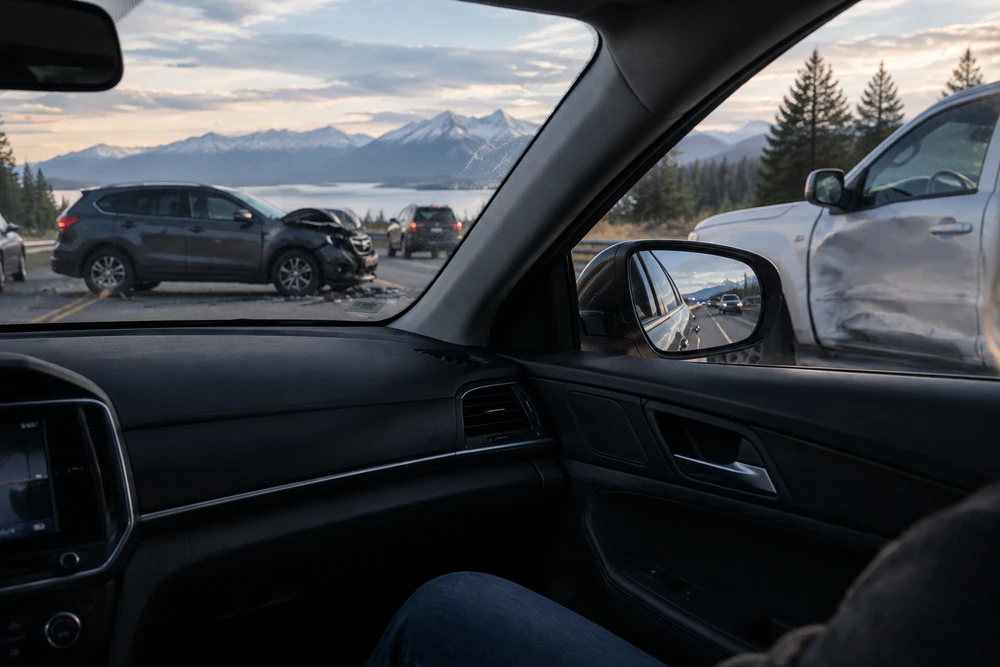
Passengers are often in an unusual position after a serious car accident. You may have done nothing to cause the crash, yet you are the person dealing with the ambulance ride, medical appointments, missed work, and an insurance process you never expected to enter.
The situation can feel even more uncomfortable when the driver of the vehicle you were riding in is a spouse, relative, friend, or coworker. If that driver made a mistake, does pursuing an injury claim mean you are suing someone you care about? What if another driver was also at fault? And which insurance company is supposed to pay?
For passengers injured around Polson, Ronan, Kalispell, Highway 93, or elsewhere in Montana, the answer depends on how the crash happened and which insurance policies apply.
A Local Example
Imagine two friends driving north on Highway 93 toward Kalispell. The driver begins turning left as an oncoming vehicle approaches. The vehicles collide, and the passenger suffers a broken wrist and a serious shoulder injury.
The passenger did not control either vehicle. But determining who is legally responsible may still require looking closely at both drivers. Did the turning driver fail to yield? Was the oncoming driver speeding or distracted? Did both actions contribute to the collision?
For the injured passenger, the important question is not simply which car they were sitting in. It is whose conduct caused the crash and what insurance coverage is available for the resulting injuries.
A Passenger Can Have a Claim Even When the Driver Is a Friend or Family Member
One of the hardest parts of a passenger claim can be personal rather than legal. People sometimes hesitate to pursue compensation because they were riding with someone they know. They may worry that making a claim means taking money directly from that person.
In many automobile injury cases, however, liability insurance exists specifically to respond when an insured driver causes injury to another person. The claim is generally handled through the applicable insurer, subject to the policy terms and the facts of the accident.
That does not mean every passenger claim is simple or that coverage automatically applies. But an injured passenger should not assume that a personal relationship with the driver eliminates the possibility of an insurance claim.
More Than One Driver May Share Responsibility
Some crashes have an obvious cause. Others do not. A collision may involve speeding, an unsafe turn, following too closely, distracted driving, poor lane control, or several mistakes happening at once.
Montana negligence law allows responsibility to be allocated among people whose conduct contributed to an injury. In a multi-vehicle crash, that can mean more than one driver and more than one liability policy become relevant.
For a passenger, this is especially important because the initial police report or one driver’s version of events may not tell the entire story. Vehicle damage, photographs, witness statements, roadway evidence, video, and other information can help establish what actually happened.
Which Insurance Policy Pays a Passenger’s Claim?
There is no single answer for every accident. If another driver caused the collision, that driver’s bodily-injury liability coverage may be an important source of recovery. If the driver of the vehicle carrying the passenger caused or contributed to the crash, that driver’s liability coverage may also need to be evaluated.
Other coverage can matter as well. Depending on the policy language and circumstances, uninsured or underinsured motorist coverage, medical-payments coverage, an employer’s policy, or coverage associated with another vehicle may need to be reviewed. A rideshare or commercial vehicle can introduce still different insurance issues.
The practical lesson is simple: do not stop the insurance investigation after identifying the first policy. Serious injuries can quickly exceed one source of coverage, and the complete insurance picture may not be obvious at the scene.
What If You Were Riding With the Driver Who Caused the Crash?
This is the situation that causes many passengers the most concern. Suppose you are riding with a friend who looks down at a phone, crosses the center line, and causes a collision. You are seriously injured.
Your status as that driver’s passenger does not automatically make the driver’s negligence your responsibility. The focus is on the conduct that caused the crash. If the driver was negligent and applicable liability coverage exists, the passenger may have a claim arising from that negligence.
Insurance policies can contain exclusions, definitions, and coverage limitations, so the actual policy should be reviewed rather than assuming coverage exists or does not exist.
Passengers Still Need to Protect the Evidence
Because passengers are often clearly not the person operating either vehicle, it can be tempting to assume fault will sort itself out. That is risky, particularly when drivers or insurance companies disagree about what happened.
If possible, preserve photographs, witness information, the investigating agency and report number, medical records, and information about every vehicle involved. Keep track of treatment, time missed from work, and expenses related to the injury. If a business vehicle, rideshare vehicle, or employer-owned vehicle was involved, make sure that fact is documented early.
The more serious the injury, the more important it becomes to identify evidence and insurance coverage before records disappear or memories fade.
Common Questions
Can I make an injury claim if I was only a passenger? Potentially. A passenger who is injured because of another person’s negligence may have a claim even though the passenger was not driving.
What if my spouse, friend, or relative was driving? The relationship does not by itself answer the liability or insurance question. The driver’s conduct, the policy language, and the circumstances of the crash all matter.
What if both drivers were at fault? More than one person can contribute to a collision. The available claims and insurance coverage should be evaluated based on each driver’s role in causing the crash.
What if the at-fault driver does not have enough insurance? Other coverage may be available, including potentially uninsured or underinsured motorist coverage, depending on the policies and circumstances. Every applicable policy should be identified and reviewed.
The Bottom Line
A passenger injured in a Montana car accident may be the least responsible person in the vehicle and still face one of the most complicated insurance situations afterward. The driver you were riding with, another driver, or multiple parties may be involved in determining responsibility and coverage.
If you were hurt as a passenger in Polson, Ronan, Kalispell, along Highway 93, or elsewhere in Montana, do not assume there is only one insurance policy or one possible path forward. Duckworth Law can review how the crash occurred, identify potentially responsible parties and available coverage, and help you understand the next steps in a passenger injury claim.