
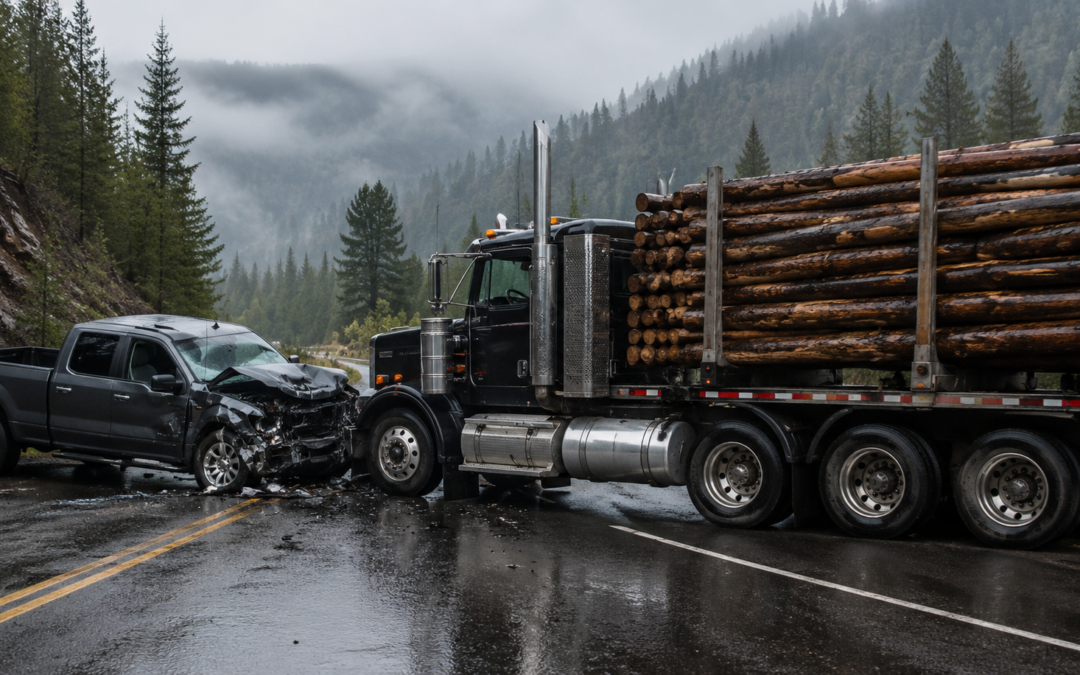
If you drive anywhere around Polson, Ronan, or Kalispell, you do not have to spend much time on the road before you run into a logging truck. They are part of life here. Timber is a real part of the Northwest Montana economy, and those trucks are moving before sunrise, through the middle of the day, and long after plenty of folks have called it quits.
Most of the time, everybody gets where they are going just fine. But when something goes wrong, these are not your typical fender-bender cases. A crash involving a logging truck or another large commercial truck tends to be more violent, more complicated, and much more expensive than an ordinary car wreck. That is true for the injuries, the insurance fight, and the legal investigation that follows.
Why These Claims Are Different
The first difference is obvious: size. A fully loaded logging truck can outweigh a passenger vehicle many times over. That affects stopping distance, turning, visibility, and the amount of force involved in a collision. Even a crash that happens at what sounds like a moderate speed can leave the people in the smaller vehicle with serious injuries.
But the weight of the truck is only part of the story. In a regular car accident, you are usually looking at one driver, one set of insurance information, and one version of what happened. In a trucking case, there may be a driver, a trucking company, a logging contractor, a maintenance company, and a separate crew responsible for loading the truck. In other words, there are often more moving parts before you even start talking about fault.
A Local Example
Picture a driver heading north on Highway 93 just outside Ronan early in the morning. The road mostly looks clear, but there are still a few patches of frost hanging on in the shaded spots. A loaded logging truck is coming the other direction around a bend. As the driver taps the brakes, the load shifts just enough to change the way the trailer tracks through the curve. The trailer drifts toward the center line, and in a split second there is a sideswipe collision.
From the outside, it may look like a simple lane-position crash. But once you start asking the right questions, it gets a lot more serious. Were the logs properly secured? Was the truck overloaded? Had the driver been on the road too long? Was the equipment maintained the way it should have been? Was the company following basic safety rules, or cutting corners to keep things moving? That is what makes these claims different. What looks simple at first can turn into a much larger investigation once somebody starts pulling on the thread.
Logging Trucks Bring Their Own Risks
Logging trucks are not hauling neatly boxed freight. They are carrying heavy, uneven loads that can shift, roll, or affect the balance of the truck if they are not secured correctly. Add in narrow two-lane highways, steep grades, long curves, wildlife crossings, and quick weather changes, and the margin for error gets pretty thin.
That matters in Northwest Montana because the roads themselves are part of the story. A truck moving through the hills near Kalispell or along the highway south of Polson is not dealing with the same environment as a delivery truck on flat city streets. Drivers have to account for road conditions, weight, visibility, and terrain every single trip. When they fail to do that, the consequences can be severe.
Safety Rules Often Matter More Than People Realize
Commercial trucking is governed by rules that do not apply to ordinary passenger vehicles. Drivers may be subject to limits on how long they can stay on the road. Trucks must be inspected and maintained. Loads have to be secured properly. Driver qualifications and training can also become part of the picture.
Those details are not just technicalities. If a fatigued driver stayed behind the wheel too long, that matters. If brakes, tires, or steering components were not maintained, that matters. If the load was not secured the way it should have been, that matters too. In a serious injury case, those behind-the-scenes facts can make the difference between a vague explanation and a clear showing of negligence.
Evidence Gets More Complicated Fast
Truck accident cases usually involve more evidence than a normal collision. There may be driver logs, maintenance records, inspection reports, load tickets, dispatch records, GPS information, and onboard electronic data. Some of that evidence is controlled by the trucking company, which means it is not something an injured person can easily collect on their own.
That is one reason these cases should be taken seriously early. The more time passes, the easier it becomes for records to disappear, memories to get fuzzy, and the story to get shaped by whoever got there first.
The Insurance Fight Is Usually Bigger Too
Because the injuries in truck cases are often more serious, the insurance coverage is usually higher than in a typical car accident. That sounds good, and sometimes it is. But it also means the insurance company has more money on the line, and when that happens, the pushback tends to get stronger.
These companies often move fast. They investigate quickly, preserve their own evidence, and start building defenses right away. Sometimes they will argue the weather was the real problem. Sometimes they will say the injured driver was in the wrong place or made the wrong move. None of that means they are right. It just means these cases are rarely simple, and they are almost never treated casually by the other side.
The Bottom Line
Truck and logging truck accidents are part of driving in Northwest Montana, but when they happen, they are a different animal. There is usually more damage, more investigation, more potential responsibility, and more resistance from the insurance company.
If you are hurt in a crash near Polson, Ronan, Kalispell, or anywhere else in this part of the state, understanding what makes these claims different is the first step. Because in these cases, figuring out what really happened usually takes more than looking at the dented metal on the side of the road.