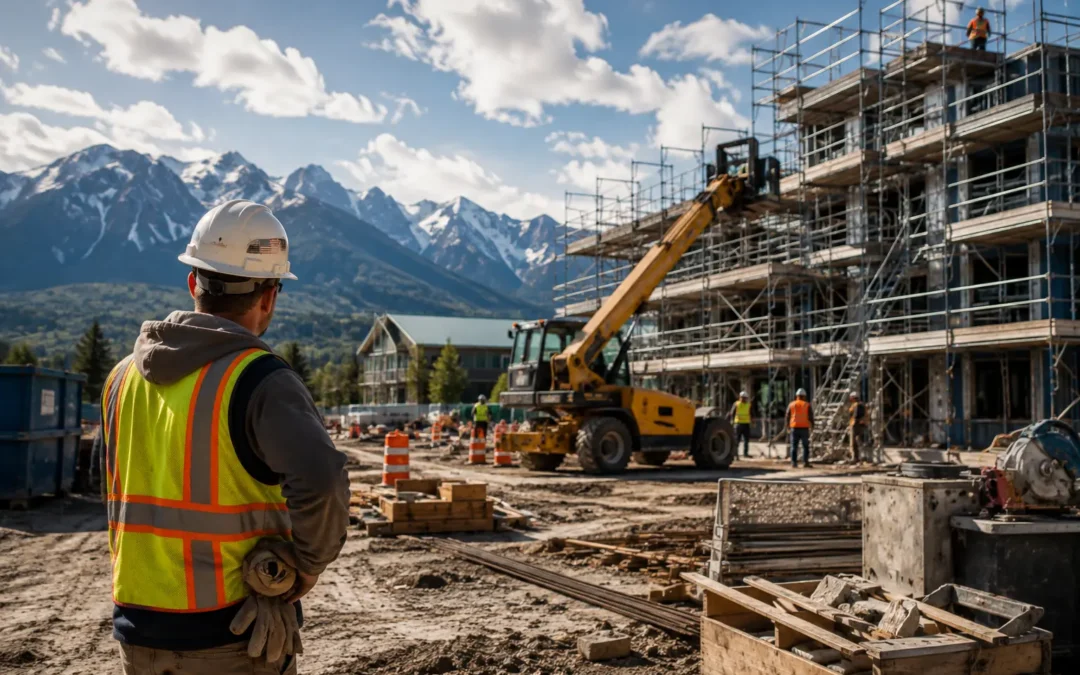
Construction work is everywhere in Northwest Montana. New homes, commercial projects, road work, remodeling, excavation, roofing, and utility projects keep crews busy around Kalispell, Polson, Ronan, and across Lake County. It is also work where one mistake can cause a life-changing injury in seconds.
A fall from scaffolding, a malfunctioning lift, a trench collapse, a dropped load, or an equipment accident may look like a straightforward workers’ compensation case. Sometimes it is. But construction sites are rarely controlled by just one company, and that can make the legal picture more complicated.
A Local Example
Picture a carpenter working on a commercial project near Kalispell. The carpenter works for one subcontractor. Another company has erected the scaffolding. A general contractor oversees the site. While the carpenter is working above ground level, part of the scaffold gives way and the worker falls, suffering serious back and shoulder injuries.
Workers’ compensation may cover the employee’s job-related injury. But that may not answer the whole question. If another contractor improperly assembled the scaffold, failed to inspect it, or created the dangerous condition, there may be a separate issue of responsibility that deserves investigation.
Workers’ Compensation Is Usually the Starting Point
For an employee injured in the course of covered work, Montana’s workers’ compensation system is generally designed to provide benefits without requiring the worker to prove that the employer was negligent. Depending on the claim, benefits can include medical treatment and wage-loss or disability benefits.
In exchange, workers’ compensation generally limits an employee’s ability to sue the employer for ordinary negligence. That is why many injured workers are told that workers’ comp is their only option.
On a construction site, however, the employer may be only one of several companies involved.
Construction Sites Have Multiple Layers of Responsibility
A typical project can involve a property owner, general contractor, subcontractors, equipment suppliers, delivery companies, engineers, and independent trades. Each may control a different part of the site or a different piece of equipment.
If the injured worker’s own employer is responsible, the claim may stay primarily within workers’ compensation. But if a separate company created the hazard, supplied defective equipment, operated a vehicle negligently, or failed in a duty it independently owed, a third-party claim may also be possible.
That distinction matters because a third-party personal injury claim and a workers’ compensation claim do not provide exactly the same remedies.
Falls Deserve More Than a Quick Explanation
Falls are among the most serious construction accidents. They can involve ladders, roofs, scaffolds, lifts, unfinished stairways, floor openings, or unprotected edges. After a fall, it is easy for the explanation to become “the worker slipped” or “someone lost their balance.”
But the real questions may be much more specific. Was the walking surface safe? Was fall protection available and appropriate? Was a ladder or scaffold properly selected and maintained? Had somebody removed a guardrail? Was the worker directed into an area that was not ready for use?
Those details can determine whether the incident was simply an on-the-job accident or whether another party’s conduct contributed to it.
Equipment Injuries Can Point to Different Defendants
Construction workers rely on lifts, skid steers, cranes, saws, nail guns, compactors, loaders, excavators, and other machinery every day. When equipment fails, the cause is not always obvious.
A machine may have been poorly maintained. A safety device may have been removed. Another contractor may have operated it incorrectly. A rental company may have supplied equipment with a problem. In some cases, the equipment itself may be defective.
The label “equipment accident” does not identify who is legally responsible. That takes an investigation into ownership, maintenance, training, operation, and the condition of the machine.
Independent Contractor Status Can Matter
Construction also involves a mix of employees and independent contractors. Montana has specific rules for independent contractor status, and simply calling someone a contractor does not always settle the issue. The actual working relationship and applicable coverage matter.
For an injured person, employment status can affect whether workers’ compensation applies and which parties may be legally responsible. It is another reason not to assume the paperwork tells the entire story before the facts are reviewed.
Evidence Can Disappear Quickly on an Active Jobsite
Construction sites change by the hour. Scaffolding comes down. Equipment gets moved or repaired. Openings get covered. Crews leave. Surveillance footage can be overwritten. That makes early documentation especially important.
Photographs, incident reports, witness names, equipment information, contracts, inspection records, and safety documentation may all become relevant. In a serious case, preserving evidence before the site changes can be one of the most important early steps.
Common Questions
Can I receive workers’ comp and still have a claim against another company? Potentially. A third-party claim may exist when someone other than the employer or another protected party contributed to the injury.
What if I was blamed for the accident? Do not assume that ends the claim. Fault can be disputed, and responsibility may be shared among more than one person or company.
What if I am called an independent contractor? The label alone may not answer every legal question. Montana has rules governing independent contractor status and workers’ compensation coverage.
Why does it matter who controlled the equipment or work area? Control can help identify which company had responsibility for the condition, task, or equipment that caused the injury.
The Bottom Line
A serious construction injury in Kalispell, Polson, Ronan, or elsewhere in Northwest Montana may involve more than a workers’ compensation form and an insurance adjuster. The jobsite may include several companies, several insurance policies, and several different responsibilities.
Workers’ compensation may be one part of the recovery. A careful investigation can determine whether somebody outside the employment relationship also contributed to the accident. Duckworth Law can review the circumstances, identify the parties involved, and help an injured worker understand which legal paths may be available.